At a Glance
- Etymology
- Golden-Era Talanese. Dominion was the Golden Empire's word for its crown heartland, the land the throne held directly; red for the iron earth of the mine country. The returners kept the name. Demonym: a Red, the Reds, across the Hafra; Dominion folk in formal use.
- Position
- Sumendar's long western coast. A wedge about 1,000 miles from north to south, some 350 miles wide in the north, narrowing to the southern point. West and south, the Hafra; north, the Midarra behind a coastal range, with Balatur Erui about 100 miles across the Midarra's mouth; north-east, No Man's Land; east, Haraour Eliza; south-east, Lioaru's shore across the bay. Burdineyja's Hafra islands lie about 200 miles off the west coast, and Auran about 285 miles south-west of the point.
- Terrain
- About 191,700 square miles, the largest country in Sumendar. A range runs along the Midarra coast, and the Midarra shore behind it has no port of note. A cluster of mountains stands inland in the north, about 150 miles short of No Man's Land, with Hyseat, the sealed city, in it. Forest on the north-west and south-west coasts; two rivers crossing the country west to the Hafra; a small dune field in the south; a forested valley down Haraour's border to the bay. Between the held coast and the mountains lies the Vaota, forest grown over the old heartland's fields; in the foothills and at the cluster's southern foot, Anokula, the red lakes.
- Character
-
A homeland won back for a people who mostly live at sea.
The Ship-TownsThe MusterThe AskingThe QuartersThe EmbraceThe VaotaAnokula - Peoples
- About 1.1 million at home and 1.5 million abroad: some 1.35 million in the quarters of the Hafra's ports and 150,000 aboard. Sorted by no ancestry: the fleet made the people. Dwarves are the most numerous, the old heartland's stock; beside them live Sumendar's other peoples, Azarketi among the crews, and whoever sailed with the fleet over eight centuries.
- Tongue
- Folau at home and among the crews; Talanese for the state, the ranks, the ship's gear and the trade, the deepest imperial loan layer on Talan. In the quarters abroad, the port's tongue outside the door.
- Faith
- Shuun at sea, Komo ashore.
- Rule
- A navy. Every house is entered on a ship's muster roll, rank is office, and the Admiralty at Saegate governs the whole under the Admiral, chosen by the flag officers from among themselves.
- Capital
- Saegate, on the southern point, about 30,000.
- Founded
- The name in the Golden Era; the fleet as a polity in the flight of 1321 MR; Saegate's line unbroken from before the breach; the country won back from 2135 MR.
The Ship-Towns
2. The first ship-town, from the deck. Forty-odd roofs along the shore, and every one of them a boat turned over. The small ones are fishing boats; the hall in the middle is a whole carrier, keel to the sky. From the water it looks like a fleet that sank the wrong way up.
3. The harbour-master's house. The keel is the roof-tree and the ribs are the rafters. The planks still lie over one another the way they did at sea, so the rain runs off them the way the water did. He has cut his door where the hull was once patched, and kept the patch. I came here to draw the Empire.
Along the west coast the towns are roofed with ships. The fleet came home from 2135, after eight centuries at sea, to a coast that had been overrun; Saegate alone had stood, and it is built in stone. The returners built with the timber they had, which was their ships: the crews ran their hulls up the beaches and broke them into houses. Inland, where no hull was ever hauled, the towns are timber and stone.
A hull laid keel-up is a roof: the keel its ridge, the ribs its rafters, the planks still overlapping the way they did at sea. A town is about forty roofs. The small ones are fishing boats, and the hall in the middle is a whole carrier.
The roofs come in two colours. The isiler hulls from Three Pines stand black and need nothing, since isiler keeps no rot. The home-built hulls take pit-red, a paint ground from the spoil of the red lakes, and so a ship-town seen from the water is black and red.
Each ship-town keeps its ship's bell on a frame in the square, the ship's name cut round the rim; it rings for a boat coming in and for the tide. Each house goes by its ship's name, and so does what it makes, and the ship's figurehead hangs over the door.
4. A figurehead over a baker's door. A woman with her arms full of fish, salt-white, painted fresh this spring. The house goes by her ship's name, and so does the bread: in the queue they ask for a loaf from the Mahu. I was meant to spend this morning at the milestone on the coast road.
The Fleet That Came Home
Under the Golden Empire this was the crown heartland, held by the throne directly. The imperial capital, Hyseat, stood in the northern mountains among the mines; Saegate, on the point, was the Empire's sea-gate, and the emperor's fleet was built in its yards.
In 1321 MR the miners under Hyseat broke into something deep below the mountain, and the Corrupted God's first spawn came up through the capital. The heartland was overrun first. The emperor's fleet sailed from Saegate that year with as many as it could carry; others fled east, into Haraour through Jaurei. Saegate held behind its walls. By 1325 the Empire had fallen.
For eight centuries the people lived at sea. The fleet's command held them together. It found harbours along the Hafra, borrowed or bought, and its crews became the Hafra's carriers, so that a Dominion quarter grew in port after port. Burdineyja's islands sheltered the fleet in the worst years. Every carrier still called at Saegate.
When the Corrupted God was wounded in 2135, the fleet came home. Its crews beached their hulls along the west coast and broke them into towns, and the country was won back from what held it: the spawn and their nests, and the mortals who had moved in, squatters, wreckers and holdfasts. Some of those were entered on a muster and stayed, and are Reds now. In the 2140s the returners sealed Hyseat. About 2300, when the first cloudship's binding took Auran's silver, Dominion carriers brought the silver to the mainland.
The line runs unbroken from before the breach, and what it carries is the Dominion. The Reds claim the crown land the Empire held directly and nothing else of the Empire's, neither its throne nor its wider ground. They have no emperor. The navy holds the Dominion.
The public account says the Golden Emperor died with his capital. He died about 1330 MR, after an engagement against a spawn-wave, at the hands of officers of his own fleet. His war against the Corrupted God was starving the provinces the fleet was carrying people out of, and a party of its officers went up from Saegate in the Embrace and killed him. The first Admiral was among them.
The Admiralty's first log holds the account in their hand, and their houses are on the Dominion's rolls today. They refused the throne they had emptied: that is why the Dominion claims nothing of the Empire's, keeps no emperor, and has its Admiral chosen by the flag officers. (See ../../timeline.md, ⚿ GM Secret: The Golden Empire: The Real History.)
The Muster and the Admiralty
Every house of the Dominion is entered on a ship's muster roll, and the ships are the state. A ship-town is a ship on the roll, and its harbour-master is that ship's officer; a quarter abroad is the shore-berth of a ship that still sails; the farms of the south stand on rolls too. Entering a muster is joining the Dominion, and the squatters and holdfasts of the return joined that way. A house taken off its roll is struck, and a struck house is Dominion no longer.
Rank is office. A captain governs a ship, its muster, and the town it came ashore as. A commodore governs a coast, or the quarters of a stretch of the Hafra. The flag officers sit together at Saegate as the Admiralty and choose from among themselves the Admiral, who serves until she strikes her flag or the board removes her. Her flag flies from the Embrace in Saegate's harbour, and she strikes it there. The Admiralty commissions its captains from examined officers with sea-time, and by interest, a senior officer's backing, about as often as by the examination. Admiral Vailea Ballast Fetu, of the Fetu, holds the flag now.
An envoy abroad deals with the Admiralty's port-officer, who keeps the Dominion's berths and tolls in that port; at Saegate, with the Admiral, who signs the Dominion's treaties. A mole or a bridge is built by the Admiralty's yard, with labour mustered from that coast's ships as service, and the yard is paid from the share the Dominion takes of every cargo carried under its flag.
Once a year each ship's roll is read aloud, and every name answers aboard. At home the beached ship holds it under its bell on the town's beaching day. Abroad the quarter holds it at the berth, the first time its ship comes in after that day. Kin answer for those away from every berth, the adventurer, the scholar, the sailor signed onto a foreign hull, the one who married inland: aboard, at Thekkavar.
On the frontier and in a fight at sea, a captain's orders are absolute, and the Admiralty's word waits until the action ends.
Before anything that puts the whole muster at hazard, a captain must put it to the muster and hear its answer: at sea, sailing into doubtful weather; ashore, pushing into the scar, moving the town, taking new ground. The captain may overrule. The asking and the answer go into the log, and a captain who overruled and lost answers for it before the board. I was asked is how a Red says they had their say.
To govern, a Red must have served at sea. A farmer in the south is on a roll and is asked, and holds no office. Ground a crew has cleared belongs, by one reading, to the ship whose crew cleared it, and by another to the Admiralty, and both readings are argued before the board.
What a Red Is Called
A Red carries a rating, a given name, a sea name, and a ship: Admiral Vailea Ballast Fetu. Everyone is on a roll, so everyone is rated: Land from birth until the first voyage, then Hand, Able, Mate, Captain, Commodore, Admiral. One who never sails is Land for life, and a farmer who sailed once at fifteen is Hand for life.
The given name is Folau and is the one used at home. The sea name is Talanese, and a crew gives it when something earns it, a deed, a habit, a look, on the first run or years later; it is kept for life, whatever rank follows, and it is the name used aboard and in the ports. Many Hands carry none for years, and some never do. A Land rarely has one: the usual way is to stow away, since the crew that finds a stowaway often names them, and they come home still Land. The ship comes last, and changes with the muster.
Given (Folau)
Sea names
Ships
Whole names
Saegate and the Fleet
1. The point, from the deck. Saegate on its rock at the end of the country: walls down to the water, a harbour inside them, and the town above in stone. The captain says it is the one town on this coast that stood. I drew it for the walls. I meant to come back to the harbour, and by then we had sailed.
Saegate stands on its rock at the end of the country, walled down to the water, with its harbour inside the walls and the town above in stone. It is the fleet's home port, about 30,000 people, and every Dominion carrier calls there. Its yard is a foundry, a rune-shop and a refit yard in one, working in shifts, and rust is on everything iron in it.
A handful of the Golden Empire's own ships are still in commission at Saegate: the emperor's fleet, built in these yards and sailed from them in 1321. They have been kept up plank by plank, and hardly a timber in them is original. The imperial marks wore away with the repairs, each carver replacing a board with what she knew. Their rune-plates are copied line for line by shipwrights who follow the pattern without the whole of its meaning, and the Dominion's own designs follow them, simpler and weaker, still good. Two things in the imperial ships nothing modern matches. One is the hold that keeps: it makes fresh water from salt, keeps food, and lands a cargo as it was loaded, and it carried the people through the exile and is why the Hafra hires Dominion carriers. The other is their guns.
The flagship is the Emperor's Embrace, on the roll in full and the Embrace in speech, and the houses of her muster go by Embrace.
The long-haul carriers are isiler hulls ordered at Ontzola and paid for partly in iron: fastenings, anchors, fittings. At Saegate each gets an imperial-pattern hold, and an isiler hull with a Dominion hold is a Dominion carrier. The coast, the fishing and the short hauls to Auran, Lemersa and Gesalkai go in home-built hulls of the Vaota's timber.
Saegate's foundry casts the guns for ships at sea: salt-proof, fired from a rolling deck, built for the recoil on a moving hull. The yard sells guns of its own pattern, iron from the red lakes with rune-work copied from the imperial guns, to anyone who comes for them; the imperial patterns stay in the fleet. With its handful of imperial warships the Dominion is one of the Hafra's sea powers, beside the Unlit of Three Pines.
The Embrace carries a weapon, every port on the Hafra says, and no two ports agree what it does. It burns a fleet to the waterline; it sinks an island; it can be fired once and never again. Each telling makes it larger, and the Admiralty lets the tellings run.
The weapon is real, and it is unlike the tales. The Emperor had a gun built into the Embrace for his counterattack on the Corrupted God, made to fire with his own Wellspring-direct power, and it has never been fired. The Admiral knows what the founders wrote in the first log: that it is for the god under the mountain, and that it fires with the Emperor's hand. She has no word for what his hand carried.
The Admiralty takes its share of Auran's cargo in kind: a jar of starlight and a vial of silver from every run, kept at Saegate. Auran's rain is Wellspring source-fluid shaped by light (see ../lioaru/auran.md, ⚿ GM Secret: the Elden's taps). The yard has tried both in the gun. It warms, and stops. How much it would take is unknown at Saegate, and so is whether it needs another light.
The Frontier
7. The mountains. At evening, far inland to the north-east, a darker line under the cloud. We land at Tuta tomorrow and I go inland. The guides there take adventurers up.
The held country is the coast and the south, about 40,000 square miles. North and east of it the Vaota covers the old heartland's fields, and beyond the Vaota lies the scar country around Hyseat: the nests, the old galleries, ground still healing. Clearing the Vaota is the reclaiming. A frontier town clears by day and keeps the watch by night; the cleared timber goes down to the coast for hulls, and the burns send smoke over the country inland. The ground under the forest is red, and the red dust gets into the clearing crews' hems and the creases of their hands.
The red lakes are the Empire's open pits, flooded and running red with iron, in the foothills and at the cluster's southern foot. Their water drains into the western river, and the river runs red past Tuta to the sea. The Dominion's iron comes from open pits there. It digs open-cast only, never below daylight, and has sunk no shaft since the return. Pit-red is ground from the lakes' spoil.
Where the Corrupted God first took hold, nests of spawn survive, and cleared ground is less safe than the Reds would like. The Admiralty pays a bounty for every nest cleared, through Tuta, and parties of adventurers come to earn it.
Tuta stands where the western river leaves the coastal forest, the landing for the road inland. The scar road runs about 250 miles up the valley to Hyseat, and nobody takes it without a guide. The guides take parties up: scholars, the curious who pay for the look, and the adventurers who come for the bounty. At Tuta the Reds bet on the parties, on whether one comes back whole, and when.
The old imperial capital stands in the mountains of the north, about 150 miles short of the border with No Man's Land, and the breach of 1321 lies under it. The returners sealed it in the 2140s, and the Admiralty keeps the seal. Since the bindstone rush of 2527 the Admiralty's riders have been out to look at No Man's Land's badlands as well.
The chronicles say the Golden Emperor died with his capital. Dominion folk say the city was sealed to keep him in, and children are told he is waiting under Hyseat.
The Carrying
The Dominion lives by freight, and the Dominion goes to its trade more than its trade comes to it. Its carriers take a share of every cargo under its flag, and the partners are fixed by the sea:
Two days out from the point: most of the island's cargo goes out in Dominion hulls from Siyabask, the drawn rain in sealed jars and the silver under guard.
On Balatur Erui: salt cargo to the Weighhouse, where it changes hulls for the Midarra.
Across the bay: grain from Lemersa, in trade and in the Dominion's lean years; carried out of the valley, it keeps.
On Three Pines: the long-haul hulls, paid for partly in iron.
Wherever there is a quarter.
The home makes timber, the everyday trade, and iron, the prize. It buys grain in a lean year, finished goods, and hulls. In an ordinary year it feeds itself: fish all along the coast, the farms of the south, and the fields reclaimed behind the ship-towns. In a lean year the coast still eats, and the frontier towns go short first.
The few who come from outside come for the scar or for the guns. There is no rail; a line would have to cross the scar country, and the sea is the Dominion's road. Ashore there are cart roads in the south, the coast road with its milestones, and the scar road; coast boats run between the ship-towns.
The Quarters Abroad
6. Two crews. Ours, and a crew at the next berth whose people have kept a quarter in Ontzola for four generations. They sing the same song in two versions, and stop at the third line to argue it. Both crews are the Dominion's.
Most Reds live abroad, about 1.35 million of them in the quarters of the Hafra's ports. A quarter is a street or two by the berth: the warehouses, the chandlery, the carriers' cargo, and the houses of a ship's muster that has kept its shore-berth there for generations. Inside, the speech is Folau; outside the door, the port's own. A quarter's year runs by its ship's comings-in, and when its ship comes in, the quarter goes down to the berth.
The quarter at Ontzola, on Three Pines, has berthed the houses of the Foki for four generations. The Dominion's long-haul carriers are isiler hulls, and a Three Pines hull is ordered at Ontzola in person, so the Dominion keeps its people where the order book is.
The port a house lives in changes nothing on the roll. A house changes muster only by being entered on another, and its people answer at their own ship's call wherever they live. What holds a quarter to the Dominion is the carrying itself: its berth, its convoys and its cargo all run under the Admiralty, and a quarter that broke away would lose all three.
The Call to the Quarters
"Every house that answers aboard in a Hafra port was entered on a roll at Saegate. One season in four generations is what I am calling for. Their captains will ask them, as they must, and I will read the answers."
"I put the Admiralty's call to my muster on the Ontzola quay. Two hundred houses answered aboard at the spring muster; when I asked who would go and clear the Vaota, thirty hands went up, and old Able Mosi Dry Foki asked whether it could be cleared from here."
The frontier has reached the edge of the scar, and the clearing wants hands. Under the rule that a coast's ships owe the Admiralty labour as service, the Admiralty has begun to call service from the quarters abroad: houses that have lived in Ontzola and other Hafra ports for four generations, most of whom have never seen the point, called home for a season to clear the Vaota. Each quarter's captain must put the call to the muster before answering it.
"My crews bring the iron down from Anokula, Saegate casts it, and the guns ride on every carrier the quarters sail in. The quarters are welcome to ask what guards their convoys."
The Admiralty and the frontier captains want the hands. The clearing is the reclaiming; the iron at the red lakes casts the guns; and a captain is promoted on the record of what her command has done. The quarters answer that their work and their lives are in the ports, and that they already pay for the Dominion in the share of every cargo they carry. A house that refuses outright is struck. Some quarters have sent hands, and some have not yet answered.
Daily Life
Most of the home lives inland, in the held south: farm country on the old crown land, market towns of timber and stone, barns and doors painted pit-red. The plough still turns up imperial roof-tile. On the coast the ship-towns fish on the tide and work the boatyard to the bell. At Saegate the yard and the foundry run in shifts under the Admiralty's windows. On the frontier the day is the clearing, the burns and the night watch, and the open pits at Anokula.
The coast smells of tar, the red rivers of iron, and the country inland of smoke from the burns. The coast eats fish, and the south its own bread. Kept food in sealed jars is the carriers' food and the quarters'. Every crew sings the same shanty, every quarter has its own third line, and two crews at neighbouring berths stop at the third line to argue it.
A Red asked where they are from names a ship: which ship? is the question. On the roll is one of us; struck is gone from the Dominion; I was asked is I had my say. The Reds' vice is the odds on the parties at Tuta.
A visitor sees a poor coast of boat-roofed towns and takes them for the Dominion, and asks where a Red is from and hears a ship's name. A Red knows that most of the home lives inland on farms and most of the people live abroad, and that a quarter four generations in a foreign port is as Dominion as Saegate.
A child is entered on its house's roll at birth and rated Land. From about ten it works in the harbour or the fields. At about fifteen it sails one run with its ship or a carrier and comes home Hand, and it is asked for the first time at its ship's next asking; the landfolk of the south sail their run too, by custom. The young keep one thing they are not supposed to: stowing away on a carrier for a run before their time. The crew finds them, works them hard and brings them home, and the captain logs it. The young of the quarters stow away the other way round, on a carrier bound for Saegate, to see the point.
Shuun is kept at sea, at casting off and on the water. Komo is kept ashore, at the foundry, the burns and the hearth. Aboard, the captain speaks the words at a launch, at a breaking-up, and at a burial at sea; ashore, Komo's clergy speak them where there are any.
Named Figures
The Admiral: of the Fetu; flies her flag in the Embrace. Her sea name is her first crew's: she was sick below for the whole of her first run.
Master of the Foki, whose quarter berths at Ontzola.
Flag officer for the northern coast, over the frontier.
Of the Ontzola quarter, quoted by his captain.
Scholar of Thekkavar's Lantern of Natural Philosophy, bound for Hyseat in 2532 to study what came up out of the breach; the sketchbook's author.
The Sketchbook
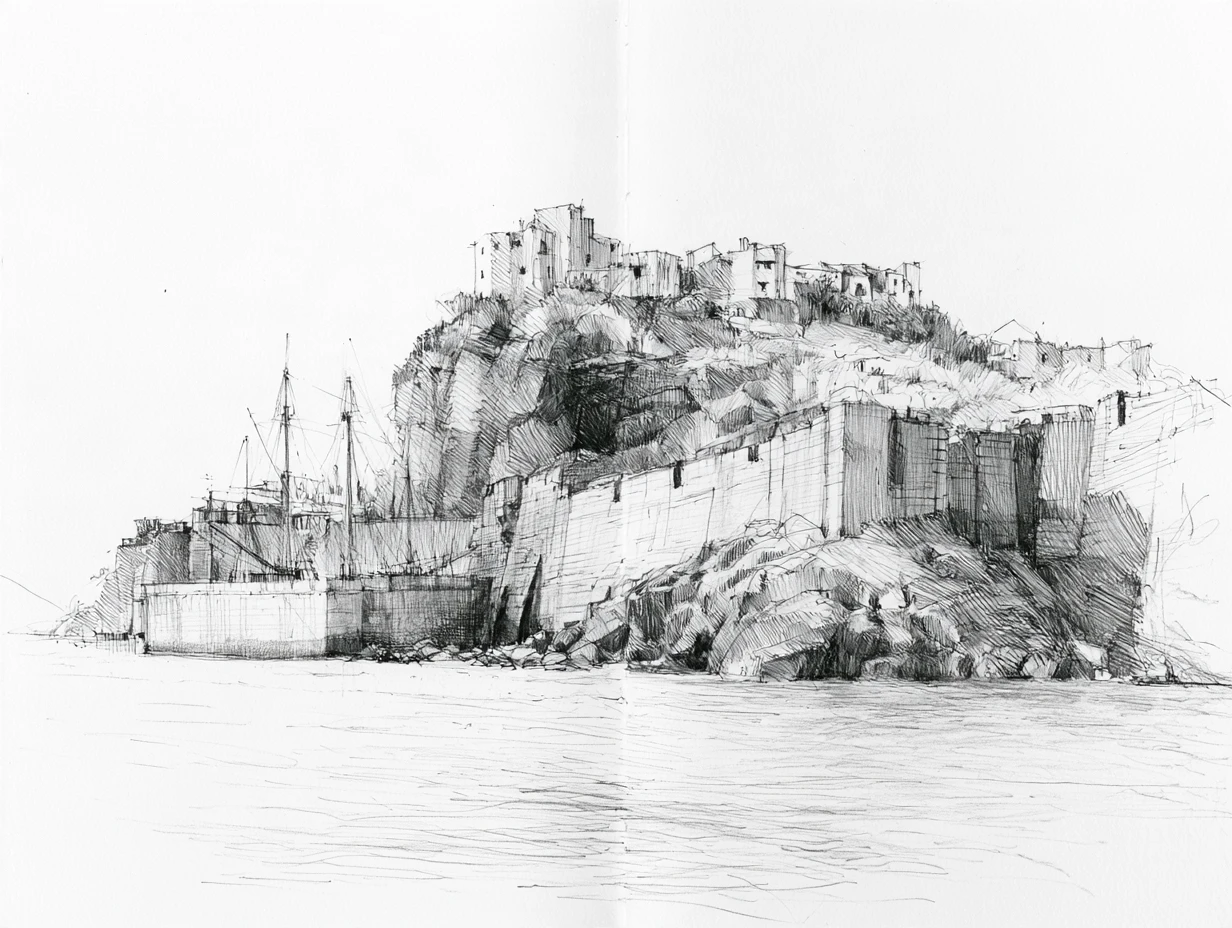
Saegate on its rock at the end of the country: walls down to the water, a harbour inside them, and the town above in stone. The captain says it is the one town on this coast that stood. I drew it for the walls. I meant to come back to the harbour, and by then we had sailed.
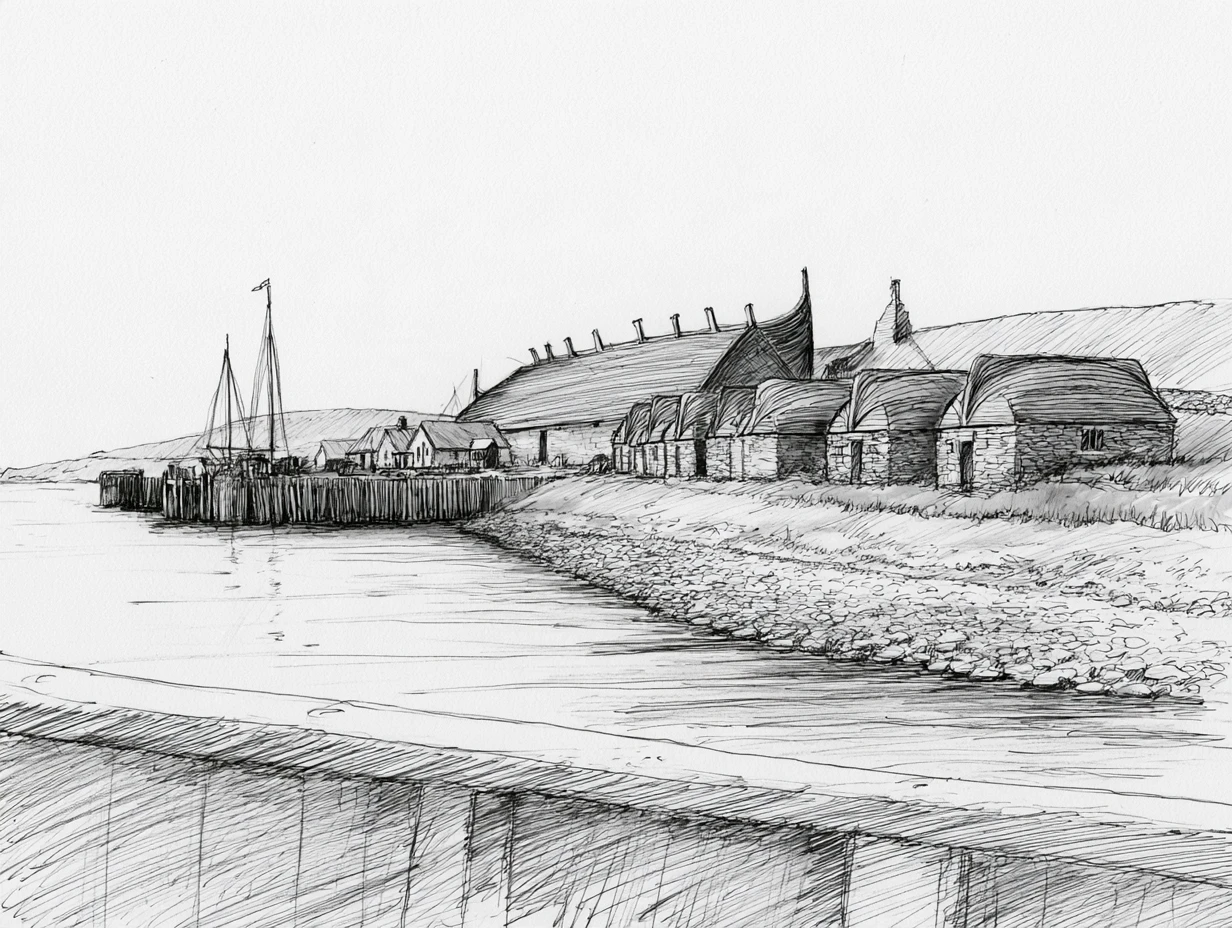
Forty-odd roofs along the shore, and every one of them a boat turned over. The small ones are fishing boats; the hall in the middle is a whole carrier, keel to the sky. From the water it looks like a fleet that sank the wrong way up.
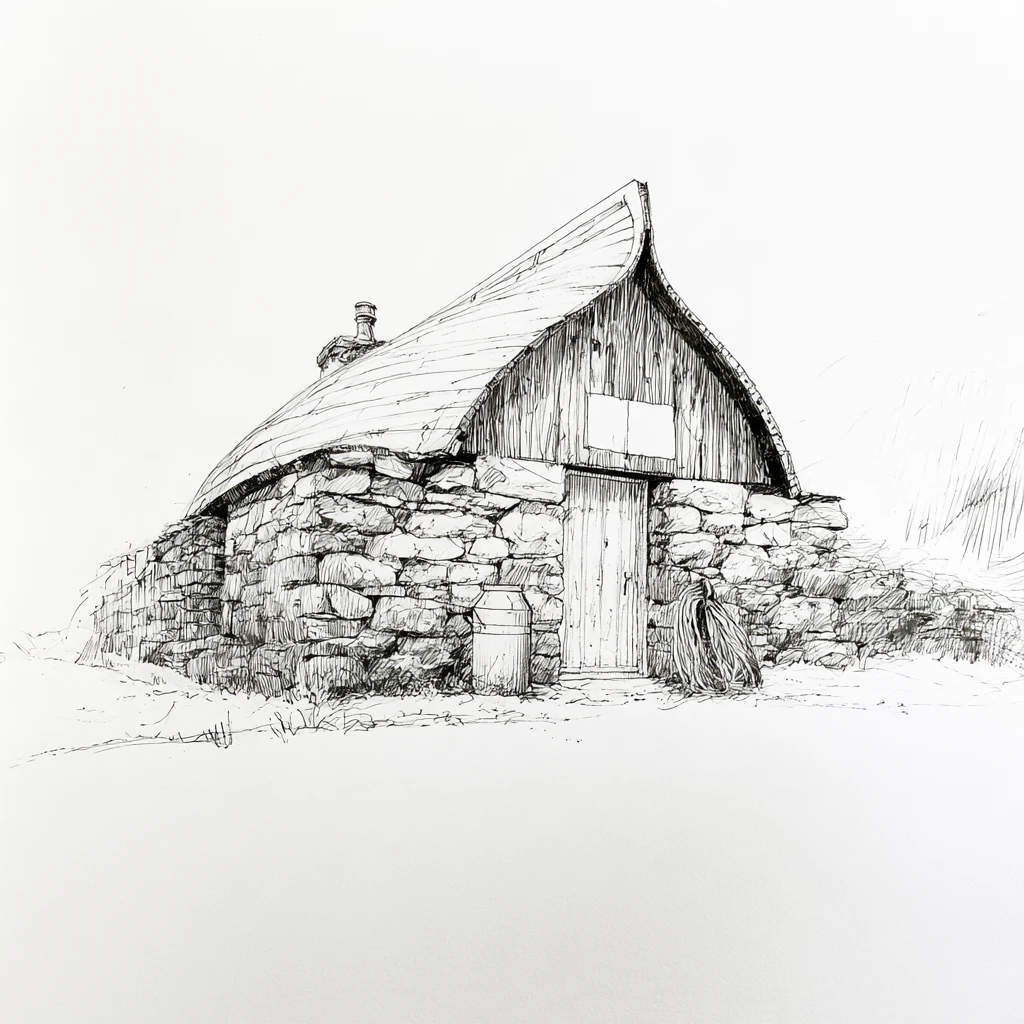
The keel is the roof-tree and the ribs are the rafters. The planks still lie over one another the way they did at sea, so the rain runs off them the way the water did. He has cut his door where the hull was once patched, and kept the patch. I came here to draw the Empire.
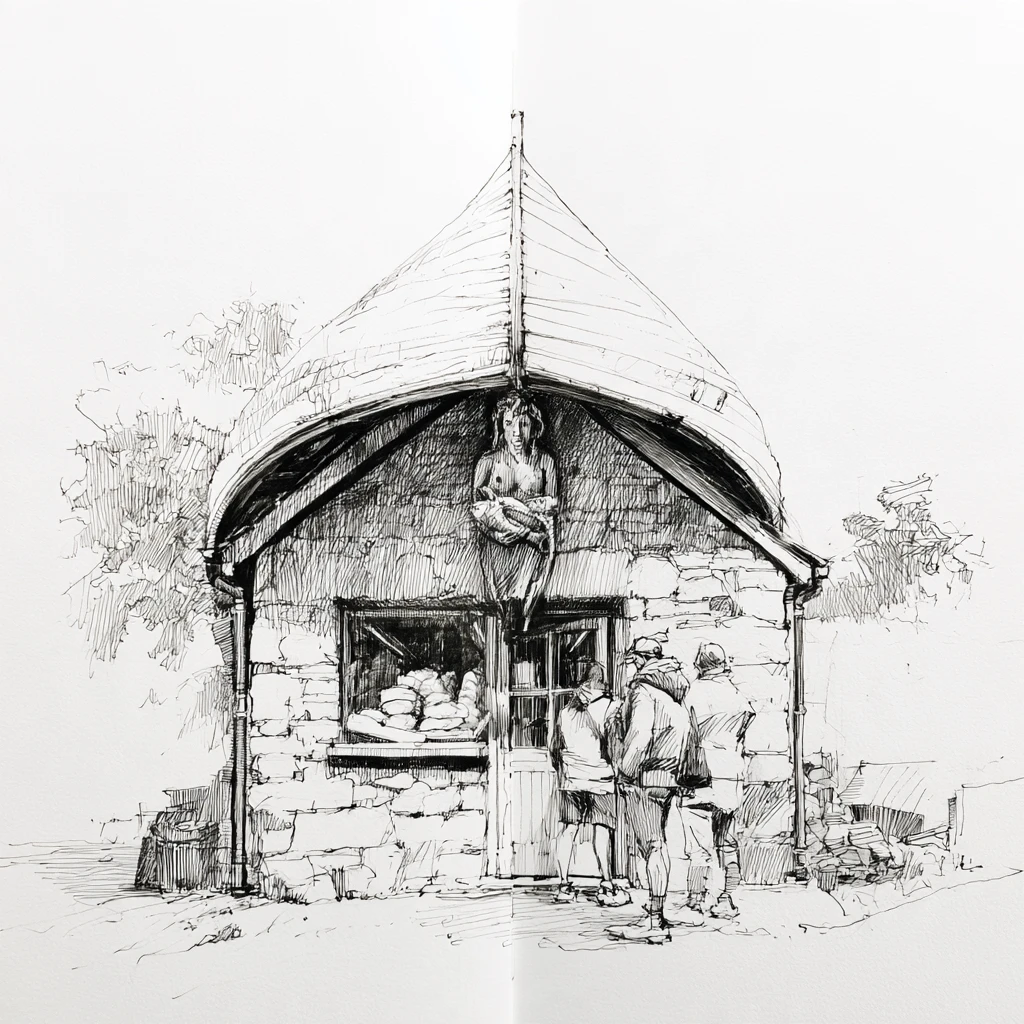
A woman with her arms full of fish, salt-white, painted fresh this spring. The house goes by her ship's name, and so does the bread: in the queue they ask for a loaf from the Mahu. I was meant to spend this morning at the milestone on the coast road.
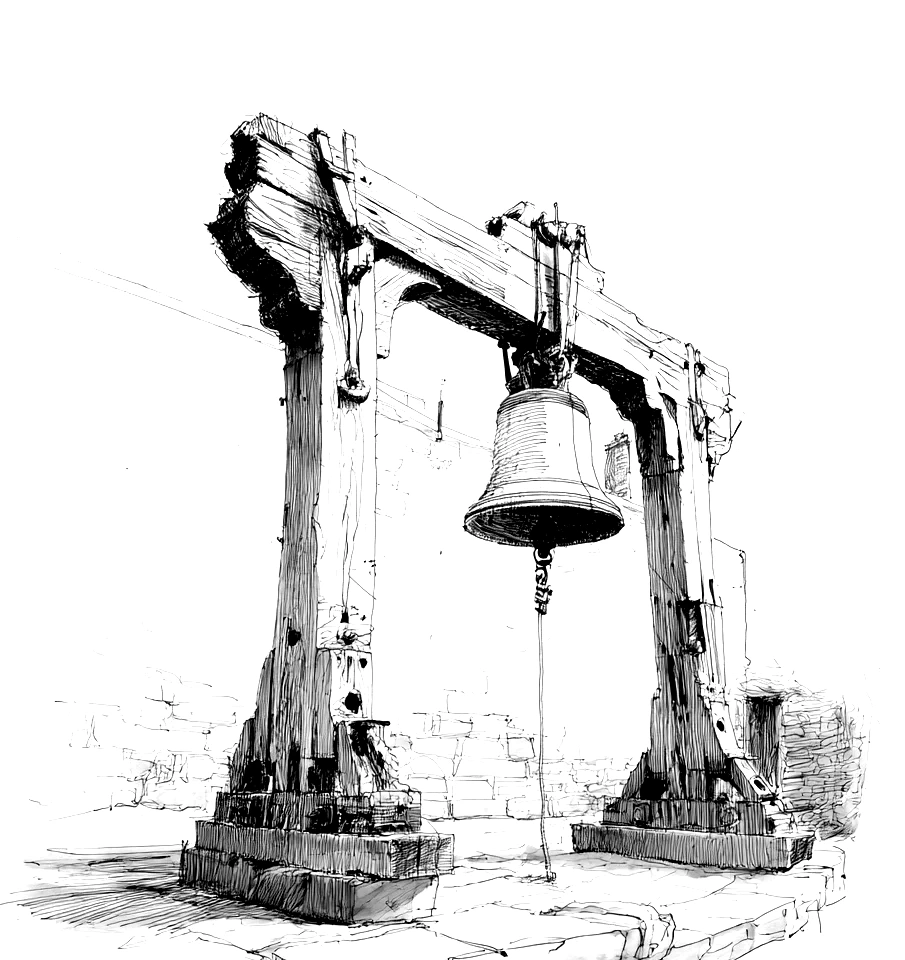
Where a town at home would keep a clock, this one has a ship's bell on a frame in the square, the ship's name cut round its rim. It rang twice while I drew it, for a boat coming in and for the tide.
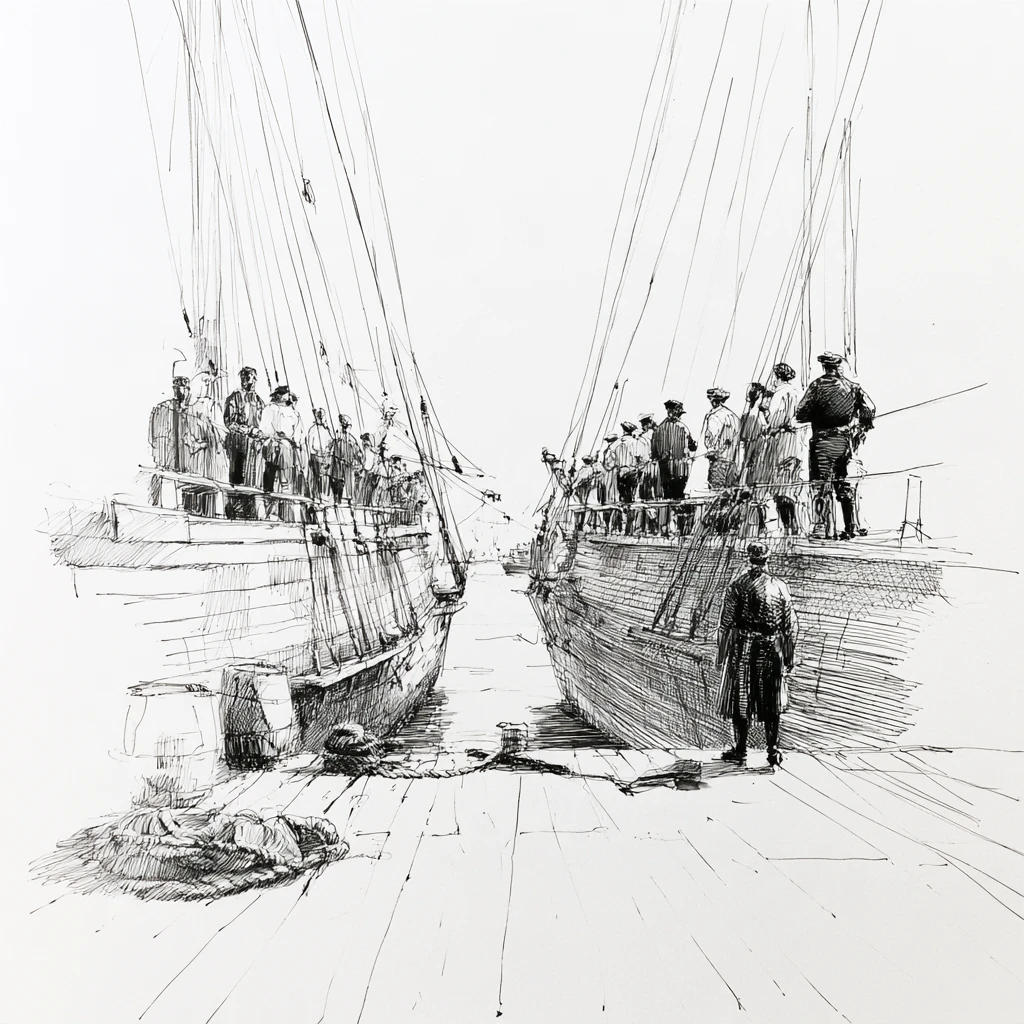
Ours, and a crew at the next berth whose people have kept a quarter in Ontzola for four generations. They sing the same song in two versions, and stop at the third line to argue it. Both crews are the Dominion's.
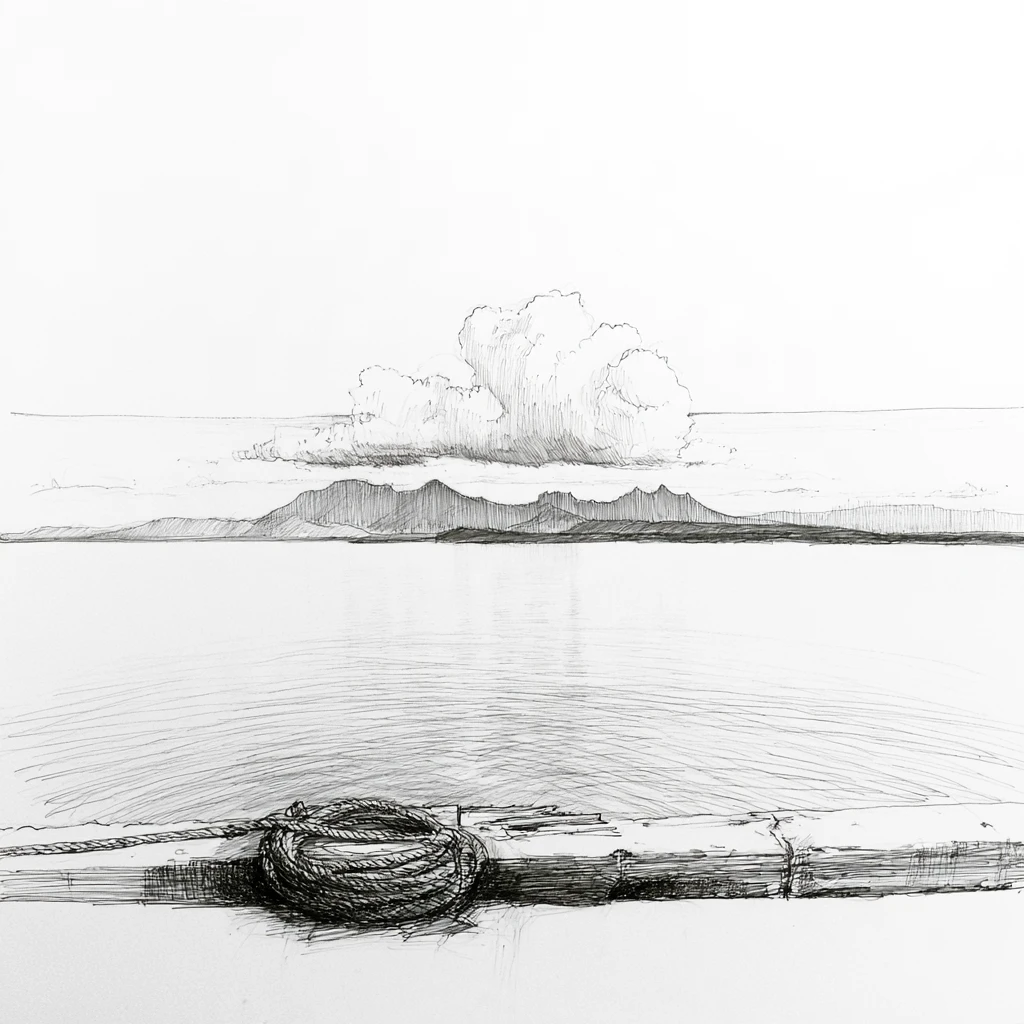
At evening, far inland to the north-east, a darker line under the cloud. We land at Tuta tomorrow and I go inland. The guides there take adventurers up.
Continue Reading
- Sumendar → · The Fire domain and its peoples.
- The Golden Empire → · The Empire whose crown land this was, and whose fleet sailed from Saegate.
- Auran → · The island of the craters, whose cargo goes out in Dominion hulls.
- Three Pines → · Ontzola's yards, where the long-haul hulls are ordered.
- The River Duchies → · Lemersa's grain, across the bay.
- Haraour Eliza → · The garden in the ring, east across the border.
- No Man's Land → · The ungoverned country past Hyseat.
- Transport → · The Hafra's carriers and sea powers.
⌬ Open in the Chronicle Record
- The ship-towns by name beyond the Mahu's.
- The coasts and their commodores.
- The quarters by port beyond Ontzola.
- The imperial ships by name and number beyond the Embrace.
- How Hyseat was sealed, and how the seal is kept.
- The road trade with Haraour.
- The Midarra shore behind the range.
- Burdineyja's side of the exile.